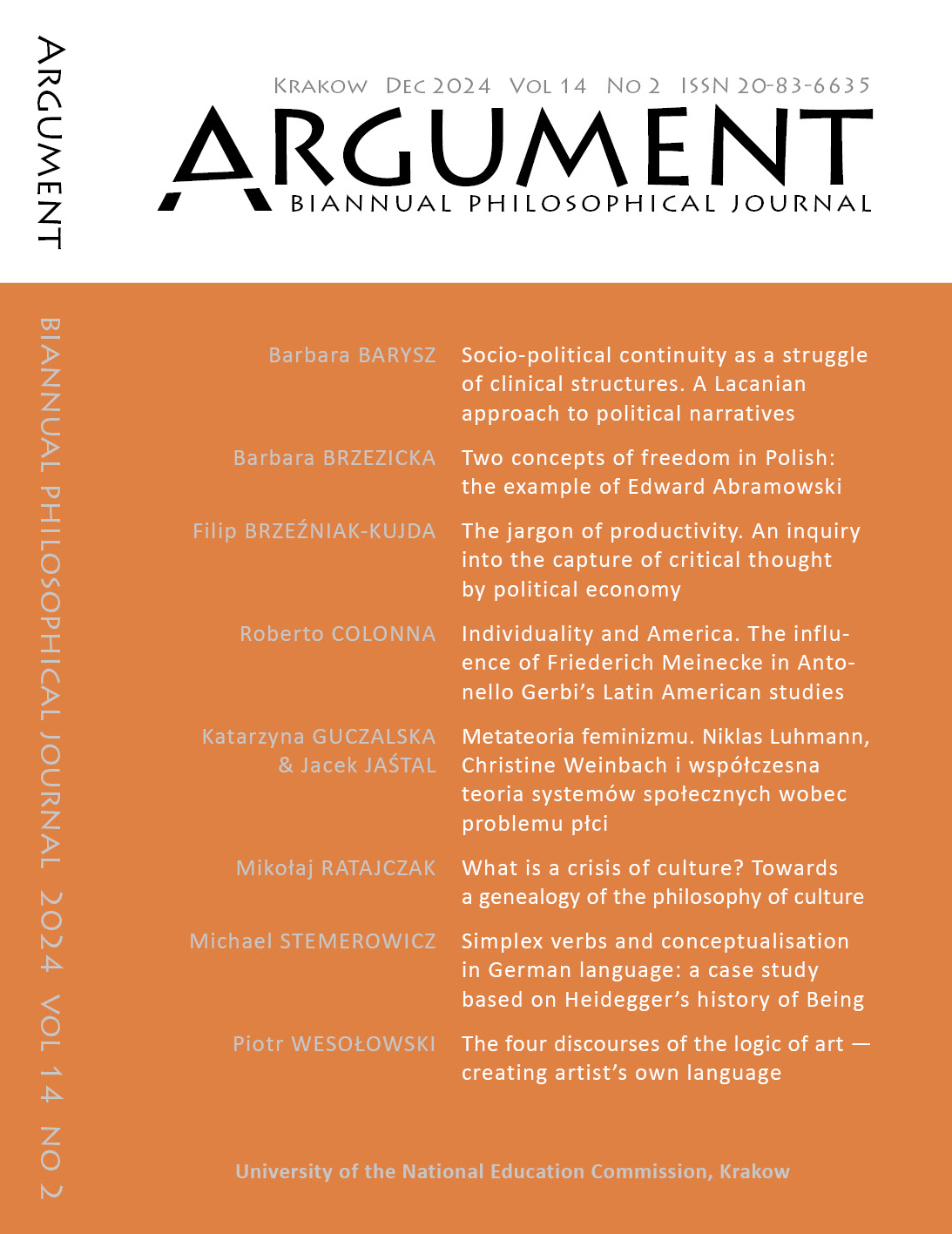
What is a crisis of culture? Towards a genealogy of the philosophy of culture
DOI:
https://doi.org/10.24917/20841043.14.2.5Keywords:
crisis, crisis of culture, philosophy of culture, genealogy of crisis, Georg Simmel, Ernesto de Martino, Roberto EspositoAbstract
The article engages with a recent discussion in philosophy and social sciences on the function and the history of the concept of crisis by proposing a short genealogical investigation of the concept of a crisis of culture. Similarly to other uses of the notion of crisis, a crisis of culture is a term that has been widely used in philosophy, the humanities and the social sciences, however, without being precisely defined or analysed. For this reason, the critical inquiry into the function and meaning of crisis in philosophy formulated here takes the form of a genealogy of philosophy of culture. Instead of attempting to provide a definition of the concept of crisis, the article traces how the notion of crisis — in particular a crisis of culture — played a definite role in formulating early theories of the philosophy of culture and how various authors used this notion to mark out the philosophy of culture as a separate field of inquiry. Special attention is given to authors — like Georg Simmel and Ernesto de Martino — who went against the dominant tendency to treat crisis as a threat or a problem to be overcome and instead described a crisis of culture as a defining element of culture itself — and maybe even the main problem of the philosophy of culture.