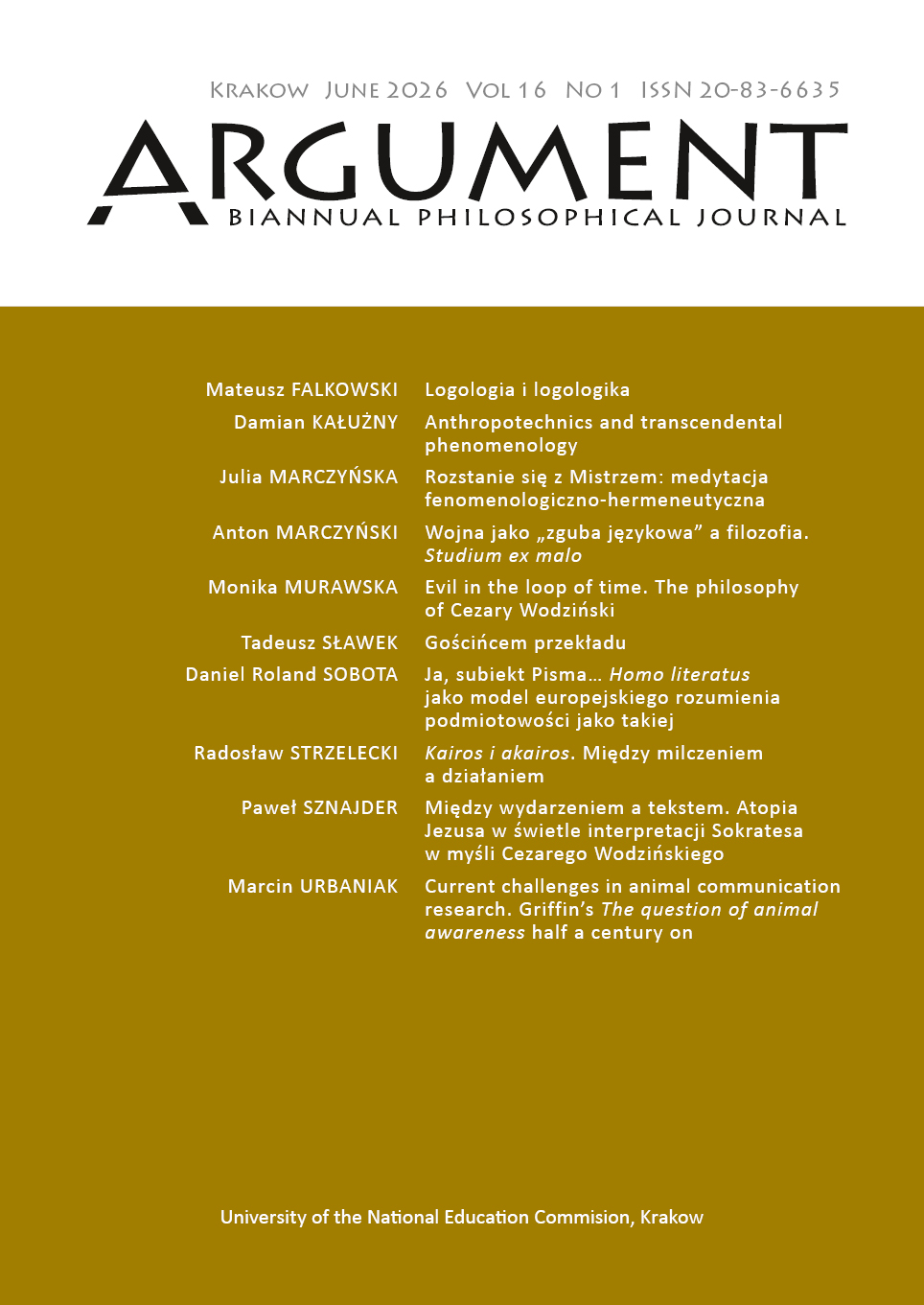
Wojna jako „zguba językowa” a filozofia
Studium ex malo
DOI:
https://doi.org/10.24917/20841043.16.1.2Słowa kluczowe:
wonder, evil, experience and concept, aporia of articulation, silence, exressibility, polemos, phenomenology, ontology, hermeneutics, Cezary WodzińskiAbstrakt
War as a ‘linguistic loss’ and philosophy. Studium ex malo: The article undertakes a philosophical consideration of war, conducted ex malo — through the prism of evil, understood as an orienting point for thinking about limit‐experiences. War is approached as a ‘linguistic loss’ in its affinity with evil but also its distinctness from evil — not as an object susceptible to neutral conceptualization, but as an experience that simultaneously demands articulation and compromises eloquence, rendering silence problematic as well. In this sense, the question of war becomes a question concerning the conditions of possibility for philosophical questioning itself and the competence of philosophy in the face of limit‐experiences. The argument unfolds in dialogue with the thought of Cezary Wodziński and selected motifs from the philosophies of Lévinas, Agamben, Heraclitus, Hegel and Heidegger, revealing different ways to situate war within ontological and historical horizons, as well as the tensions arising from their relation to the problem of evil. The article brings
to light the resistance that the experience of war poses to attempts at conceptual grasp, along with the aporias of its articulation. Three fundamental obstacles are distinguished: insufficient experiential immediacy, the normative uncertainty of utterance, and the excess
and traumatic character of experience, which undermine both discourse and silence. Rather than offering a definition of war, the study proposes a recognition of its limit‐status: when war is considered through the prism of evil, philosophy is confronted with the boundaries
of its own expressibility and with the loss of a more primordial competence — the discernment of good and evil.
Bibliografia
Agamben, G. (2008). Co zostaje z Auschwitz. Archiwum i świadek (Homo sacer III). (Przeł. S. Królak). Warszawa: Sic!.
##plugins.generic.googleScholarLinks.settings.viewInGS##
Arystoteles (1988). O duszy. (Przeł. P. Siwek). Warszawa: PWN.
##plugins.generic.googleScholarLinks.settings.viewInGS##
Arystoteles (2013). Metafizyka. (Przeł. K. Leśniak). Warszawa: Wydawnictwo Naukowe PWN.
##plugins.generic.googleScholarLinks.settings.viewInGS##
Boisacq, É. (1938). Dictionnaire Étymologique de la Langue Grecque étudiée dans ses Rapports avec les Autres Langues Indo‐européennes. Heidelberg — Paris: Carl Winter/Librairie Ancienne Honoré Champion.
##plugins.generic.googleScholarLinks.settings.viewInGS##
Chantraine, P. (1968–1980). Dictionnaire Étymologique de la Langue Grecque. Histoire des Mots. T. 1–4. Paris: Éditions Klincksieck.
##plugins.generic.googleScholarLinks.settings.viewInGS##
Hegel, G.W.F. (1969). Zasady filozofii prawa. (Przeł. A. Landman). Warszawa: PWN.
##plugins.generic.googleScholarLinks.settings.viewInGS##
Heidegger, M. (1990). Rektorat 1933/1934. Fakty i myśli. (Przeł. M. Żmudzińska). Aletheia, 1(4).
##plugins.generic.googleScholarLinks.settings.viewInGS##
Heidegger, M. (1995). List o humanizmie. (Przeł. J. Tischner). W: M. Heidegger. Znaki drogi. Warszawa: Fundacja Aletheia.
##plugins.generic.googleScholarLinks.settings.viewInGS##
Heidegger, M. (2002). Kim jest Zaratustra Nietzschego? W: M. Heidegger. Odczyty i rozprawy. (Przeł. J. Mizera). Kraków: Wydawnictwo Baran i Suszczyński.
##plugins.generic.googleScholarLinks.settings.viewInGS##
Heidegger, M. (2004). Objaśnienia do poezji Hӧlderlina. (Przeł. S. Lisiecka). Warszawa: Wydawnictwo KR.
##plugins.generic.googleScholarLinks.settings.viewInGS##
Heidegger, M. (2008). Bycie i czas. (Przeł. B. Baran). Warszawa: Wydawnictwo Naukowe PWN.
##plugins.generic.googleScholarLinks.settings.viewInGS##
Heidegger, M. (2017). Podstawowe zagadnienia filozofii. (Przeł. W. Rymkiewicz). Warszawa: Fundacja Augusta hr. Cieszkowskiego.
##plugins.generic.googleScholarLinks.settings.viewInGS##
Heidegger., M., Augstein, R. & Wolff, G. (1977). Tylko Bóg może nas uratować (wywiad dla „Der Spiegel”, 23 IX 1966). (Przeł. M. Łukasiewicz). Teksty: teoria literatury, krytyka, interpretacja, 3(33), 142–161.
##plugins.generic.googleScholarLinks.settings.viewInGS##
Heraklit (2005). Zdania. (Przeł. A. Czerniawski). Gdańsk: słowo/obraz terytoria.
##plugins.generic.googleScholarLinks.settings.viewInGS##
Jurewicz, O. (2000–2001). Słownik grecko‐polski. T. 1–2. Warszawa: Wydawnictwo Szkolne PWN.
##plugins.generic.googleScholarLinks.settings.viewInGS##
Kant, I. (2001). Krytyka czystego rozumu. (Przeł. R. Ingarden). Kęty: Wydawnictwo Antyk.
##plugins.generic.googleScholarLinks.settings.viewInGS##
Kluge, F. (1960). Etymologisches Wörterbuch der deutschen Sprache (18. Aufl., bearb. von W. Mitzka). Berlin: Walter de Gruyter & Co.
##plugins.generic.googleScholarLinks.settings.viewInGS##
Lévinas, E. (1998). Całość i nieskończoność. Esej o zewnętrzności. (Przeł. M. Kowalska). Warszawa: Wydawnictwo Naukowe PWN.
##plugins.generic.googleScholarLinks.settings.viewInGS##
Michalski, K. (2007). Płomień wieczności. Eseje o myślach Fryderyka Nietzschego. Kraków: Znak.
##plugins.generic.googleScholarLinks.settings.viewInGS##
Nietzsche, F. (2024). Tako rzecze Zaratustra. (Przeł. W. Berent). Kraków: Vis‐a‐vis/Etiuda.
##plugins.generic.googleScholarLinks.settings.viewInGS##
Platon (2002). Teajtet. W: Platon. Parmenides. Teajtet (s. 85–192). (Przeł. W. Witwicki). Kęty: Wydawnictwo Antyk — Marek Derewiecki.
##plugins.generic.googleScholarLinks.settings.viewInGS##
Wodziński, C. (2016). Metafizyka i metapolityka. „Czarne zeszyty” Heideggera. Gdańsk: Fundacja Terytoria Książki.
##plugins.generic.googleScholarLinks.settings.viewInGS##
Wodziński, C. (2019). Światłocienie zła. Gdańsk: Fundacja Terytoria Książki.
##plugins.generic.googleScholarLinks.settings.viewInGS##
Асєєв, С. (2020). Світлий Шлях: історія одного концтабору. Львів: Видавництво Старого Лева.
##plugins.generic.googleScholarLinks.settings.viewInGS##
Дронь, А. (2025). Гемінґвей нічого не знає. Львів: Видавництво Старого Лева.
##plugins.generic.googleScholarLinks.settings.viewInGS##